
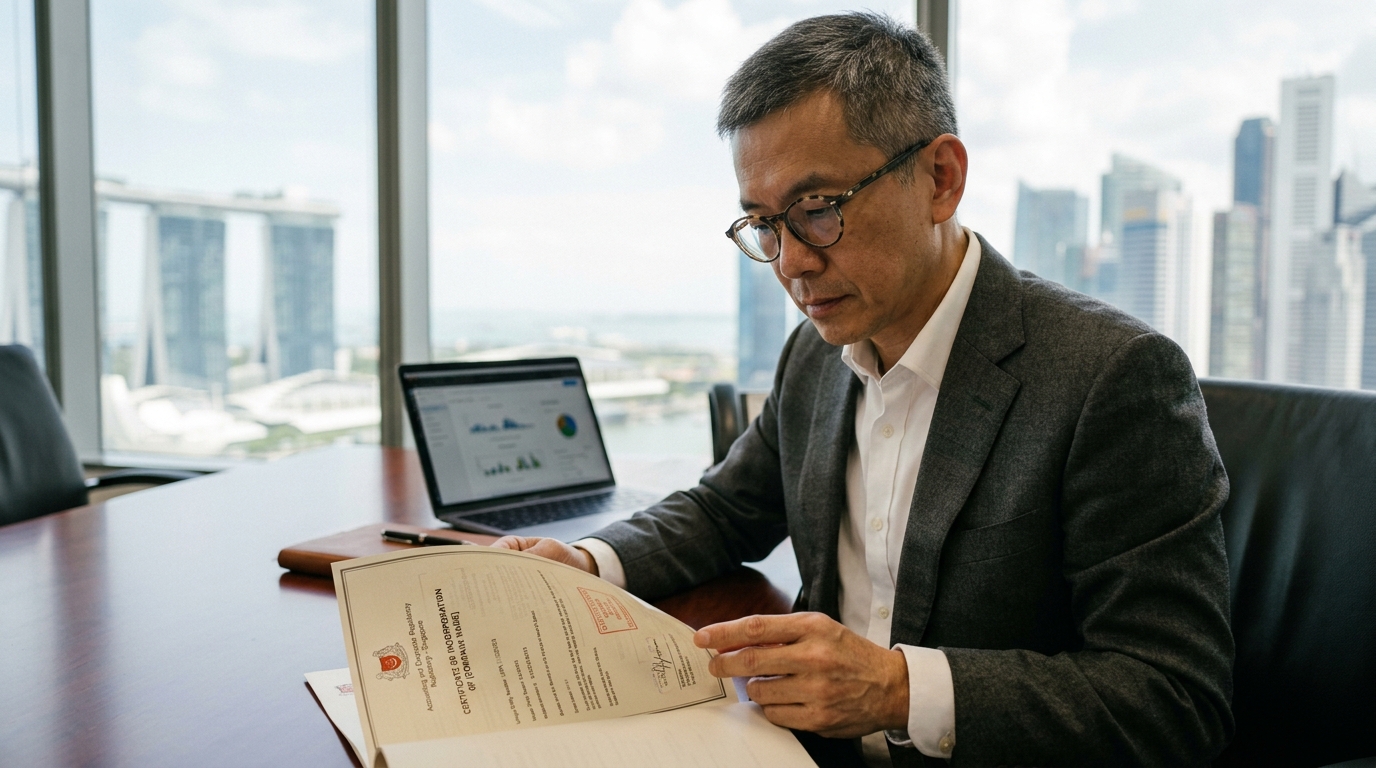
Singapore Company Registration Number Sample and How to Read It
Every legally registered business entity in Singapore is assigned an official identification number known as the Unique Entity Number (UEN). If you are reviewing a singapore company registration number sample, understanding how this alphanumeric code is structured allows you to verify business contracts, issue compliant commercial invoices, and file statutory reports with government agencies. Issued by ACRA upon successful incorporation, the UEN serves as your company’s universal identifier across all regulatory, tax, and commercial interactions.
Whether you are inspecting incoming vendor documentation or printing your own official stationery, knowing how to interpret the UEN ensures total administrative compliance.
Decoding the Modern Singapore UEN Format
A Singapore company registration number (UEN) for modern private limited companies consists of 10 characters: the 4-digit year of incorporation (e.g., 2026), a 5-digit sequential code (e.g., 12345), and a final check letter (e.g., K). This standardized identifier is mandatory on all commercial invoices and contracts.
Singapore standardized its entity numbering system to streamline cross-agency reporting across ACRA, IRAS, and customs authorities. Here is how modern UENs are structured:
Standard 10-Digit Format for Local Companies: For private limited companies incorporated after January 1, 2009, the UEN follows a structured 10-character alphanumeric formula:
**Year of Incorporation (First 4 Digits):** Indicates the year the entity was registered with ACRA (e.g., `2026`).Entity Type & Sequential Code (Next 5 Digits): A unique sequential number generated by the national database (e.g.,
12345).Check Character (Final Letter): An algorithmic verification letter (e.g.,
K).Example Modern UEN:
202612345K- **Format for Sole Proprietorships and Partnerships:** Businesses registered as sole proprietorships or standard partnerships use an 8-digit format followed by a check letter (e.g., `12345678X`).
- **Foreign Entities and Other Specialized Entities:** Foreign branch offices and representative offices feature specialized entity indicators (e.g., `T26FC1234K`).
- **Statutory Rules for Displaying Your UEN:** Under the Singapore Companies Act, every company must clearly display its registered corporate name and UEN on all business documents, including commercial invoices, official websites, receipts, and formal business letters.
Sample Breakdown Table: Identifying Different Singapore Entity Numbers
The table below provides sample entity registration numbers and explanations of their structural indicators:
| Entity Type | Sample UEN Format | Anatomy Breakdown |
|---|---|---|
| New Pte Ltd (Post-2009) | 202612345K | [2026 = Year] [12345 = Sequence] [K = Check Letter] |
| Legacy Pte Ltd (Pre-2009) | 199801234D | [1998 = Year] [01234 = Sequence] [D = Check Letter] |
| Business Name / Sole Prop | 53123456M | [53 = ACRA prefix] [123456 = Order] [M = Check Letter] |
| Foreign Company Branch | T26FC0012A | [T26 = Year 2026] [FC = Foreign Company] [0012A = Sequence] |
To ensure your incorporation documents and official UEN certificates are processed without delay, request a free consultation with our compliance experts.
Frequently Asked Questions About Singapore UEN Numbers
Is the UEN the same as the company’s GST and Corporate Tax Number?
Yes. Singapore utilizes the UEN as the single corporate tax reference number for IRAS corporate income tax filings and GST reporting.
Can a company change its UEN number after incorporation?
No. The UEN is permanently assigned to the legal entity for its entire corporate lifespan and cannot be modified even if the company changes its name.
Rapid Incorporation and Official UEN Issuance with Honey Lemon
Honey Lemon ensures your business incorporation and UEN generation are completed seamlessly within 24 hours of document submission. We deliver your full electronic Certificate of Incorporation and official ACRA Business Profile so you can commence commercial operations immediately.
Explore our fast-track business registration services on the Honey Lemon platform today.
Read More
Singapore Incorporated Company Meaning for Foreign Founders
For international founders and global investors planning to expand into Asia, understanding the singapore incorporated company meaning is the foundation for creating a resilient, scalable enterprise. Under Singapore corporate law, an incorporated company—most commonly registered as a Private Limited Company (Pte Ltd)—is recognized as an independent legal entity separate from its shareholders and directors. This legal status provides substantial commercial advantages, robust asset protection, and exceptional fiscal efficiency.
Establishing an incorporated entity in Singapore creates a clear legal barrier between personal and commercial liabilities while establishing immediate credibility with international clients, suppliers, and financial institutions.
Core Characteristics and Commercial Benefits of an Incorporated Entity
A Singapore incorporated company (Private Limited) is a distinct legal person under the Companies Act, possessing limited liability protection, perpetual succession, and independent contractual capacity. Foreign owners enjoy 100% equity ownership, capped 17% corporate tax rates, and 0% capital gains tax.
Incorporating a private company under the Accounting and Corporate Regulatory Authority (ACRA) delivers several key legal and operational benefits:
- Separate Legal Personality: An incorporated company possesses full legal capacity. It can enter into contracts, incur obligations, purchase real and intellectual property, and initiate or defend legal proceedings in its own name.
- Limited Liability Protection: The personal liability of shareholders is strictly capped at the amount of share capital they have committed. Personal assets belonging to founders remain protected against corporate debts, operational losses, or commercial litigation.
- Perpetual Corporate Succession: A Singapore incorporated company continues to exist indefinitely regardless of changes in shareholding, management, or the departure of founding members. Shares can be transferred, sold, or inherited without disrupting operations.
- Highly Competitive Tax Incentives: Singapore caps headline corporate income tax at 17%, with effective tax rates often falling below 9% for qualifying startups through the Startup Tax Exemption Scheme. Furthermore, Singapore imposes 0% capital gains tax and 0% tax on post-tax dividend payouts.
Key Differences: Incorporated Company vs. Sole Proprietorship vs. Branch Office
The table below highlights the distinct legal and tax characteristics of an incorporated company compared to other business structures:
| Feature | Private Limited Company (Pte Ltd) | Sole Proprietorship / Partnership | Foreign Branch Office |
|---|---|---|---|
| Legal Status | Separate legal entity | No separate legal personality | Extension of foreign parent company |
| Liability Risk | Limited to share capital | Unlimited personal liability | Parent company fully liable |
| Foreign Ownership | 100% foreign ownership allowed | Requires local manager | 100% foreign parent owned |
| Tax Exemption Eligibility | Eligible for Startup Tax Exemption | Individual tax rates (higher) | Non-resident tax treatment |
If you are evaluating whether a Private Limited company is the ideal corporate structure for your venture, set up a free consultation with our compliance experts.
Frequently Asked Questions on Singapore Incorporated Companies
What is the minimum capital required to incorporate a Pte Ltd?
The statutory minimum paid-up capital is just S$1 (or foreign currency equivalent). You can increase your company’s paid-up capital at any time after incorporation.
How quickly can a Singapore company be incorporated?
With all identity documents and KYC verification complete, Honey Lemon can lodge and finalize your ACRA incorporation within 24 hours.
Launch Your Singapore Pte Ltd with Honey Lemon
Honey Lemon makes company incorporation straightforward, fast, and compliant. We handle your entire setup digitally—from ACRA name approvals and constitution drafting to corporate secretarial governance and tax structuring.
Discover our comprehensive incorporation packages on the Honey Lemon platform to establish your Singapore business today.
Read More
Singapore Company Registration List Can You Access Company Records
Transparency, legal certainty, and robust regulatory oversight make Singapore one of the world’s most trusted commercial hubs. Prospective entrepreneurs, international investors, and B2B researchers frequently inquire about accessing the official singapore company registration list to inspect corporate records, perform market analysis, or carry out compliance screening. While the Accounting and Corporate Regulatory Authority (ACRA) maintains public registries, access is governed by structured statutory rules that balance public accountability with personal privacy.
Understanding what information is publicly accessible and what data remains protected allows business owners to manage corporate transparency while safeguarding sensitive personal details.
How Public Corporate Records and Privacy Work in Singapore
Singapore operates an open business registry via ACRA where company names, UEN numbers, operational status, and director names are publicly searchable. However, sensitive information—such as residential addresses and ultimate beneficial ownership records in the Register of Registrable Controllers (RORC)—remains protected under privacy laws.
Singapore’s corporate framework provides extensive public transparency while enforcing compliance with the Personal Data Protection Act (PDPA):
- Publicly Searchable Company Information: Any individual or organization can search ACRA’s registry to view basic company profiles, including entity names, Unique Entity Numbers (UEN), registration dates, legal status (Live, Dissolved, Struck Off), and primary business activity classifications (SSIC codes).
- Director and Officer Privacy Protections: Under Singapore law, company directors and officers can register an Alternate Address with ACRA (such as the company’s registered office). This prevents their private residential address from being exposed on publicly downloadable Business Profiles.
- Protected Ultimate Beneficial Ownership Data: The Register of Registrable Controllers (RORC), which identifies individuals holding significant control or more than 25% ownership, is maintained securely and accessible only to government authorities and law enforcement agencies, not the general public.
- Authorized Bulk Data Access: Regulated financial institutions, compliance agencies, and accredited research firms can obtain structured corporate data extracts via official government API gateways for legitimate anti-money laundering and KYC screening.
Public vs. Protected Corporate Information Breakdown
The table below outlines which corporate data points are publicly accessible versus those protected under Singapore confidentiality laws:
| Information Type | Publicly Accessible? | Governing Legal Framework |
|---|---|---|
| Company Name & UEN | Yes (Free Search) | ACRA Companies Act |
| Registered Office Address | Yes (Business Profile) | ACRA Statutory Filings |
| Director Residential Address | Protected if Alternate Address is registered | Companies (Amendment) Act |
| Beneficial Ownership (RORC) | Strictly Confidential (Regulators only) | Anti-Money Laundering & ACRA Guidelines |
| Annual Financial Statements | Public for non-exempt companies | Singapore Financial Reporting Standards (SFRS) |
To structure your company with appropriate privacy protections—such as alternate address registrations and professional nominee appointments—book a free consultation with our compliance experts.
Frequently Asked Questions About Corporate Data Access
Can my competitors view my company’s profit margins in Singapore?
If your company qualifies as an Exempt Private Company (EPC)—having fewer than 20 individual shareholders and no corporate shareholders—you are not required to file public financial statements with ACRA, keeping your profitability figures private.
How do I protect my personal residential address from appearing in public searches?
You can appoint Honey Lemon’s commercial address as your official Alternate Address with ACRA, ensuring your home address remains confidential on all publicly purchased profiles.
Complete Governance and Privacy Management with Honey Lemon
Honey Lemon helps global entrepreneurs establish their business presence in Singapore while applying all legally permissible privacy safeguards. We manage your statutory registers, nominee arrangements, and ACRA compliance filings with complete diligence.
Explore our full range of incorporation and corporate secretarial solutions on the Honey Lemon platform today.
Read More
Singapore Company Registration Lookup How to Verify a Business
Conducting rigorous corporate due diligence is an essential safeguard before signing commercial agreements, entering vendor partnerships, or investing capital. Performing an official singapore company registration lookup through official government channels allows business owners and investors to instantly verify the legal standing, ownership structure, and operational status of any Singapore-registered entity. The Accounting and Corporate Regulatory Authority (ACRA) maintains an open, transparent public repository that guarantees commercial integrity across the nation.
Whether you are verifying a prospective business partner or confirming your own company’s public records, knowing how to access and interpret ACRA data provides total peace of mind.
Step-by-Step Guide to Verifying a Singapore Business via ACRA
To verify any Singapore business, users can access ACRA’s BizFile+ directory for a free instant lookup using the entity’s name or Unique Entity Number (UEN). For complete verification, purchasing an electronic Business Profile (BizProfile) for S$5.50 provides verified records of appointed directors, shareholders, share capital, and registered office address.
Singapore makes business verification simple and accessible through its centralized digital infrastructure. Here is how you can perform a thorough corporate search:
- Free Instant Business Search on BizFile+: Anyone globally can conduct a free search on the ACRA BizFile+ portal using the entity name or Unique Entity Number (UEN). This basic lookup reveals the company’s official registration name, UEN, current status (e.g., "Live", "In Liquidation", or "Struck Off"), entity type (Pte Ltd, LLP, Branch), and date of incorporation.
- Purchasing an Official Electronic Business Profile (BizProfile): For comprehensive due diligence, you can purchase an official ACRA Business Profile for a nominal statutory fee (approx. S$5.50). The complete profile details primary and secondary business activities (SSIC codes), registered office address, issued and paid-up capital, and full particulars of appointed directors, secretaries, and shareholders.
- Key Red Flags to Identify: Always check whether the entity status is "Live", verify whether the listed directors match your contract signatories, and confirm that the company’s registered address is an active commercial location.
Key Data Fields Extracted from an ACRA Business Profile
The table below summarizes the key verification parameters available on an official Singapore ACRA Business Profile:
| Data Field | What It Verifies | Due Diligence Significance |
|---|---|---|
| Entity Status | "Live", "Struck Off", "In Creditors Voluntary Winding Up" | Confirms whether the business is legally authorized to trade |
| Unique Entity Number (UEN) | Standard 10-digit national identifier | Prevents identity confusion between identically named entities |
| Officers & Directors | Full names, identification numbers, appointment dates | Confirms authorized signatories for commercial contracts |
| Issued & Paid-Up Capital | Total currency and paid capital amount | Reflects shareholder equity commitment and financial standing |
If you need assistance verifying complex corporate records or ensuring your own entity profile is updated correctly with ACRA, schedule a free consultation with our compliance experts.
Frequently Asked Questions About Business Verification in Singapore
Is an ACRA Business Profile accepted as official legal proof worldwide?
Yes. The ACRA electronic Business Profile is an official government-authenticated document recognized by international banks, courts, and corporate registries globally. It can also be legalized via Apostille through the Singapore Academy of Law (SAL).
Can I check if a Singapore company has filed its annual returns?
Yes. The Business Profile states the date of the last Annual General Meeting (AGM) and the date up to which accounts and annual returns have been lodged with ACRA.
Maintain Flawless Public Corporate Records with Honey Lemon
Ensuring your company records accurately reflect your latest directors, shareholders, and registered office address builds instant credibility with global clients and financial institutions. Honey Lemon manages all statutory updates, board changes, and annual filings directly with ACRA on your behalf.
Review our comprehensive corporate governance and secretarial services on the Honey Lemon website to keep your enterprise in perfect standing.
Read More
Automated Company Incorporation in Singapore Is It Right for Foreign Founders
The rapid evolution of corporate technology has made it possible to submit business registrations in record time through digital portals. While exploring a swiftly automated company incorporation in singapore sounds appealing for digital founders, overseas business owners must evaluate whether purely automated self-service tools provide adequate legal safeguards and compliance support for cross-border operations. Setting up a foreign-owned enterprise involves specialized statutory requirements—including local resident directorships, cross-border anti-money laundering (AML) compliance, and corporate banking approvals—that require nuanced human guidance.
Balancing digital speed with professional advisory ensures that your company is not merely registered on paper, but structured for long-term operational success.
Automated Incorporation Platforms vs. Dedicated Corporate Advisory
Automated incorporation platforms provide swift template generation for standard domestic entities, but foreign founders face significant limitations regarding nominee directorships, complex shareholding structures, and strict corporate banking compliance. A hybrid approach combining digital onboarding with dedicated human compliance advisory delivers the highest success rate.
Understanding the operational strengths and limitations of automated software compared to professional corporate services helps founders make an informed choice:
- Where Automated Platforms Excel: Self-service digital portals offer fast document generation and automated filing for simple, domestic sole-shareholder companies with local resident founders who possess a SingPass.
- The Corporate Banking Hurdle: Automated software cannot assist with the intricate business documentation and source-of-wealth narratives required by Singapore corporate banks (such as DBS, OCBC, or UOB). Dedicated compliance advisors actively guide founders through bank onboarding requirements.
- Nominee Director Governance: For non-resident founders, appointing a local resident nominee director carries legal fiduciary responsibilities. Automated platforms often lack the customized risk assessments and prompt board resolution approvals necessary for smooth commercial transactions.
- Complex Shareholding Structures: Multi-tiered corporate shareholding, foreign parent holding companies, and specialized shareholder agreements cannot be effectively handled by rigid, standardized web templates.
Comparison: Fully Automated Portals vs. Guided Corporate Services
The table below summarizes the key operational differences between automated incorporation software and human-guided corporate service providers:
| Feature | Fully Automated Platform | Guided Corporate Provider (Honey Lemon) |
|---|---|---|
| Onboarding Experience | Self-service form filling | Digital onboarding with dedicated expert review |
| Nominee Director Handling | Basic algorithmic matchmaking | Vetted, professional nominee directorship with full legal indemnity |
| Bank Account Support | Generic referral links | Tailored business profile preparation & direct bank introductions |
| Custom Resolution Drafting | Additional cost per template | Included within comprehensive annual secretarial packages |
Before committing to an automated tool that might leave critical compliance gaps, schedule a free consultation with our compliance experts to verify the ideal incorporation approach for your enterprise.
Frequently Asked Questions About Automated Incorporation
Can automated software guarantee Singapore bank account approval?
No automated tool can guarantee corporate bank approval. Singapore banks enforce rigorous Know-Your-Customer (KYC) guidelines that assess business feasibility, target customers, and operational substance—factors requiring human advisory.
Is digital document signing legally recognized in Singapore?
Yes. Under the Singapore Electronic Transactions Act (ETA), digital signatures generated through compliant platforms are legally binding for ACRA company resolutions and constitution documents.
Combining Digital Speed with Human Expertise at Honey Lemon
Honey Lemon delivers the best of both worlds: rapid, paperless online onboarding paired with dedicated corporate secretarial specialists who oversee every filing with precision. We ensure your enterprise is registered swiftly with ACRA while remaining fully compliant and ready for banking onboarding.
Discover our digital-first incorporation solutions on the Honey Lemon platform to start your Singapore business today.
Read More
Company Incorporation in Singapore for Foreigners What Affects the Setup
Expanding into Singapore provides international businesses with direct access to dynamic Asian markets, competitive corporate tax rates, and a stable legal jurisdiction. However, accurately calculating the total company incorporation in singapore cost requires foreign entrepreneurs to look beyond introductory government filing fees and consider the full scope of first-year setup and recurring statutory obligations. Because non-resident foreign founders cannot self-register directly on ACRA’s BizFile+ portal without a SingPass, partnering with an authorized Registered Filing Agent is legally mandatory.
Understanding every cost driver upfront allows founders to budget effectively, choose the right service tier, and avoid hidden fees that often emerge after incorporation.
Comprehensive Breakdown of Setup and Maintenance Costs for Foreigners
The total cost of incorporating a company in Singapore for foreign founders typically ranges from S$700 for basic local setups up to S$2,000–S$4,500 for full foreign-founder packages. Key cost elements include ACRA statutory fees (S$330 total), local nominee director retainers, corporate secretary appointments, and registered office address services.
The overall investment required to launch and maintain a fully compliant Singapore business comprises several mandatory statutory and operational components:
- Mandatory ACRA Government Fees: ACRA charges fixed statutory fees for every new incorporation: S$15 for company name application and reservation, and S$315 for the official registration filing.
- Local Resident Nominee Director Services: Section 145 of the Singapore Companies Act mandates that every company must have at least one director who is ordinarily resident in Singapore. Overseas founders without local residency must engage a professional nominee director service, which typically involves an annual retainer fee and a refundable security deposit.
- Qualified Corporate Secretary: A company must appoint a licensed corporate secretary within 6 months of incorporation to maintain statutory registers, draft resolutions, and manage annual filings.
- Registered Commercial Office Address: Every company must maintain a physical registered office address in Singapore (not a P.O. Box) for formal government notifications and correspondence.
- Annual Accounting and Tax Compliance: Annual requirements include preparing unaudited financial statements, holding the Annual General Meeting (AGM), filing the ACRA Annual Return, and lodging Corporate Income Tax returns (Form C-S / Form C) with IRAS.
Itemized Singapore Incorporation Cost Breakdown Table
The table below outlines the standard first-year setup versus ongoing renewal costs for a foreign-owned Singapore Private Limited company:
| Service / Regulatory Item | Frequency | Estimated Industry Cost (SGD) |
|---|---|---|
| ACRA Name Reservation & Filing Fee | One-time government fee | S$330 (S$15 name + S$315 registration) |
| Corporate Secretary Retainer | Annual | S$300 – S$800 / year |
| Registered Commercial Address | Annual | S$200 – S$600 / year |
| Nominee Director Service | Annual + Refundable Deposit | S$1,500 – S$3,500 / year (+ deposit) |
| Annual Tax & Financial Statements | Annual | S$500 – S$1,800 / year depending on transaction volume |
To receive an exact, transparent cost projection tailored to your specific business model without unexpected surcharges, connect with us for a free consultation with our compliance experts.
Frequently Asked Questions on Singapore Incorporation Pricing
Can I remove the nominee director cost once I obtain an Employment Pass?
Yes. Once an international founder or executive obtains an approved Singapore Employment Pass (EP) or EntrePass and assumes the role of local resident director, the nominee director service and security deposit can be terminated.
Are there hidden fees in basic Singapore incorporation packages?
Some budget providers omit corporate secretary appointments, charge extra for drafting basic board resolutions, or impose high transfer fees if you switch agencies. Honey Lemon guarantees 100% transparent pricing with all core services itemized upfront.
Transparent, All-Inclusive Incorporation Packages by Honey Lemon
Honey Lemon eliminates pricing ambiguity by offering clear, upfront incorporation packages. From our foundational Seed Package starting at S$715 to all-inclusive foreign founder packages featuring nominee director coverage and registered office support, we ensure complete cost predictability.
Explore our complete pricing plans on the Honey Lemon packages page and start your business setup today.
Read More
Singapore Company Shareholder Information for Foreign Investors
Singapore is globally celebrated for offering an open, transparent, and welcoming regulatory environment for international founders and multinational enterprises. Understanding official singapore company shareholder information regulations is essential for overseas investors seeking to structure their business safely while maintaining complete compliance under the Singapore Companies Act. Governed by the Accounting and Corporate Regulatory Authority (ACRA), the statutory framework allows 100% foreign equity ownership across virtually all business sectors.
Whether you are establishing a standalone startup or a multi-tiered corporate holding structure, knowing your legal rights and statutory responsibilities as a shareholder ensures smooth corporate governance from day one.
Statutory Rules Governing Shareholders in Singapore Companies
Under Singapore corporate law, foreign individuals and overseas corporate entities are legally entitled to own 100% of the share capital of a Singapore Private Limited Company (Pte Ltd) without local equity participation. A private company can have between 1 and 50 shareholders with a minimum initial paid-up capital of just S$1.
When incorporating a Singapore Private Limited company, foreign investors must understand the key legal principles governing share ownership and statutory records:
- 100% Foreign Equity Ownership: Under Singapore corporate law, there are no mandatory local shareholding quotas. Foreign individuals or overseas corporate bodies can hold 100% of the issued share capital without requiring local equity partners.
- Flexible Shareholder Capacity and Quantity: A private limited company can have anywhere from 1 to 50 shareholders. Shareholders can be natural persons of any nationality or registered foreign corporate entities.
- Minimal Initial Capital Requirements: The minimum paid-up capital required to incorporate is just S$1, which can be denominated in Singapore Dollars (SGD), US Dollars (USD), Euros (EUR), or other major global currencies. Capital can be increased at any time following incorporation.
- Register of Registrable Controllers (RORC): In accordance with international transparency standards, companies must maintain an internal RORC identifying ultimate beneficial owners holding more than 25% voting rights or shares. This internal registry is protected from general public viewing but remains accessible to regulatory authorities.
Overview of Shareholder Rights and Governance Obligations
The table below outlines the core rights and compliance duties assigned to company shareholders under the Singapore Companies Act:
| Shareholder Attribute | Statutory Rule / Provision | Practical Impact for Foreigners |
|---|---|---|
| Residency Requirement | No residency requirement | Can reside 100% overseas with no travel required for setup |
| Voting & Dividend Rights | Determined by Company Constitution | Can issue ordinary or preference shares with custom rights |
| Annual General Meeting (AGM) | Mandatory within 6 months of financial year-end | Can pass written shareholder resolutions in lieu of physical meetings |
| Liability Protection | Limited to subscribed unpaid share capital | Personal assets fully protected against corporate liabilities |
Organizing statutory share registries and drafting legally binding shareholder resolutions requires precision. To ensure your ownership structure satisfies all ACRA standards, arrange a free consultation with our compliance experts.
Frequently Asked Questions About Singapore Shareholding
Can a foreign corporate entity be the sole shareholder of a Singapore company?
Yes. A foreign registered corporation or holding company can be the 100% sole corporate shareholder of a Singapore Private Limited entity, creating a fully compliant wholly-owned subsidiary.
Is shareholder information displayed on public records?
Yes. Basic shareholder information (name, address, share allocation, currency) appears on the official ACRA Business Profile. However, ultimate beneficial ownership details recorded in the internal RORC remain strictly confidential.
Secure Corporate Governance and Shareholding with Honey Lemon
From initial equity allocation and share certificate issuance to drafting shareholder agreements and filing ACRA annual returns, proper corporate administration protects your commercial rights. Honey Lemon acts as your dedicated corporate secretarial partner, ensuring all board resolutions and statutory registers remain fully up to date.
Discover our all-in-one incorporation and secretarial packages on the Honey Lemon platform to establish your Singapore business seamlessly.
Read More
Singapore Company Investment in India What Business Owners Should Know
Singapore has consistently established itself as one of the premier sources of Foreign Direct Investment (FDI) into India, serving as the preferred jurisdiction for multinational corporations, venture capital funds, and international founders. Structuring a singapore company investment in india allows global business owners to capitalize on Singapore’s robust legal framework, extensive double taxation avoidance agreements, and favorable corporate tax regime while capturing expansive growth opportunities across the Indian economy.
For international enterprises, establishing a Singapore holding company provides unmatched capital security, high institutional credibility, and operational flexibility when deploying capital into Indian operating subsidiaries or commercial ventures.
Key Strategic Advantages of Channeling Investments into India via Singapore
Investing in India through a Singapore entity provides significant tax efficiency, regulatory predictability, and seamless capital movement. Under the Singapore-India Double Taxation Avoidance Agreement (DTAA), cross-border withholding tax rates on interest, royalties, and technical services are optimized, while Singapore imposes 0% capital gains tax and 0% tax on repatriated foreign dividends.
Utilizing a Singapore Private Limited entity as an investment holding vehicle offers measurable commercial and fiscal benefits that streamline cross-border asset management:
- Double Taxation Avoidance Agreement (DTAA) Benefits: The comprehensive bilateral tax treaty between Singapore and India provides clear guidelines on dividend taxation, interest withholding, and royalties, significantly mitigating double taxation risks across cross-border revenue channels.
- Absence of Foreign Exchange Controls: Singapore maintains zero capital or currency exchange controls. International investors can freely remit capital, reinvest corporate earnings, or repatriate dividends without cumbersome foreign exchange restrictions.
- Favorable Holding Company Taxation: Singapore does not impose capital gains tax or dividend withholding tax on distributions to shareholders, ensuring maximum capital efficiency for global holding structures.
- Alignment with Reserve Bank of India (RBI) Regulations: Singapore entities represent a well-recognized and trusted investment route under the Foreign Exchange Management Act (FEMA) and standard RBI reporting frameworks (such as the FC-GPR filing for equity issuance).
Comparison: Direct Foreign Investment vs. Singapore Holding Route
The table below summarizes the key operational differences between direct foreign investment into India versus channeling funds through a Singapore holding entity:
| Feature | Direct Foreign Investment | Singapore Holding Company Route |
|---|---|---|
| Capital Gains Tax on Exit | Subject to local home country and Indian domestic tax rates | 0% Singapore capital gains tax on share disposal |
| Dividend Repatriation | Potential double taxation depending on treaty terms | Tax treaty relief under Singapore-India DTAA; 0% Singapore dividend withholding |
| Dispute Resolution | Domestic courts in investor’s home jurisdiction or India | Access to Singapore International Arbitration Centre (SIAC) |
| Investor Perception | Variable depending on origin country regulatory reputation | Tier-1 global financial reputation recognized by global VC funds |
Structuring cross-border investments requires meticulous legal and tax alignment between Indian regulatory bodies and Singapore corporate statutes. To ensure your holding entity is compliant from inception, schedule a free consultation with our compliance experts.
Frequently Asked Questions on Singapore-India Business Structuring
Does a Singapore holding company need commercial substance in Singapore?
Yes. To legitimately benefit from Singapore tax treaty provisions and avoid challenges under General Anti-Avoidance Rules (GAAR), the Singapore entity should demonstrate operational substance, including local board management, registered address, and valid corporate secretarial records.
What entity type is best for investing in India?
A Singapore Private Limited Company (Pte Ltd) is the standard vehicle chosen by venture capitalists, corporate groups, and individual investors due to its separate legal personality, limited liability, and fiscal incentives.
Build Your Cross-Border Holding Structure with Honey Lemon
Establishing an international investment vehicle in Singapore requires proactive governance, robust accounting records, and dedicated corporate secretarial oversight. Honey Lemon supports foreign investors by structuring compliant holding entities, managing ongoing statutory filings, and ensuring seamless compliance across borders.
Accelerate your regional expansion by reviewing our dedicated business structuring and incorporation packages on the Honey Lemon platform today.
Read More
Singapore Company Incorporation Providers How to Compare Your Options
Selecting the right corporate service partner is one of the most critical foundational decisions for international entrepreneurs expanding into Southeast Asia. When evaluating imc group singapore company incorporation options alongside other market alternatives, business founders must look beyond basic marketing promises to find a provider that truly aligns with their long-term growth and governance needs. Singapore’s regulatory framework, enforced by the Accounting and Corporate Regulatory Authority (ACRA), requires absolute precision in statutory reporting, timely annual filings, and ongoing compliance oversight.
Navigating this corporate ecosystem successfully demands an accredited Registered Filing Agent (RFA) that simplifies cross-border setup while safeguarding your enterprise against compliance pitfalls. Choosing an incorporation partner who combines transparent pricing, digital agility, and responsive communication ensures your Singapore venture starts on solid legal ground.
Direct Comparison: How to Evaluate Singapore Incorporation Providers
To compare Singapore corporate service providers effectively, founders should evaluate four foundational pillars: total cost transparency (year 1 vs. renewal), technological onboarding speed, statutory compliance breadth, and corporate banking approval assistance. The best provider offers transparent flat-rate billing without hidden charges for standard board resolutions or document drafting.
Corporate service firms in Singapore vary significantly in their technological infrastructure, pricing models, and service quality. To ensure your business launch remains efficient and cost-effective, evaluate prospective providers against the following essential criteria:
- Total Fee Transparency and Recurring Cost Structure: Many traditional corporate providers advertise low initial incorporation fees but charge heavily for routine subsequent services, such as second-year secretarial renewals, nominee director retainers, or standard board resolutions. Always request an itemized fee breakdown covering both year-one setup and recurring annual maintenance.
- Digital-First Onboarding vs. Traditional Bureaucracy: Modern cross-border founders require rapid remote identity verification and electronic document signing. Traditional corporate advisory firms like IMC Group often rely on manual, physical paperwork that can extend registration timelines. Modern providers use biometric verification to complete filings in under 24 hours.
- Comprehensive End-to-End Governance Support: A reliable incorporation partner supports your business well beyond day one. Look for agencies that seamlessly integrate company secretarial duties, local registered office services, nominee director arrangements, corporate tax filing with IRAS, and bookkeeping under one unified roof.
- Proven Corporate Banking Assistance: Securing a corporate bank account with major Singapore institutions (such as DBS, OCBC, or UOB) or leading digital fintech platforms (Aspire, Airwallex) is critical. Quality providers offer structured banking advisory and documentation support rather than leaving founders to navigate account opening alone.
Comparison Matrix: Traditional Corporate Agencies vs. Modern Agile Providers
The table below highlights the operational differences between legacy corporate agencies and modern, client-centric corporate service providers:
| Evaluation Factor | Traditional Corporate Agencies (e.g., IMC Group) | Modern Corporate Providers (e.g., Honey Lemon) |
|---|---|---|
| Onboarding Speed | 3 to 7 business days; manual document exchanges | Same-day / 24-hour digital ACRA lodgment |
| Pricing Structure | Modular fees with variable hourly/resolution charges | Transparent, all-inclusive flat annual packages |
| Communication Channel | Formal ticketing systems & periodic email updates | Dedicated compliance manager & direct instant messaging |
| Digital Signing & KYC | Physical notary or wet-ink courier requirements | 100% remote digital biometric KYC verification |
If you are currently comparing different service providers or planning to transition your existing corporate secretarial portfolio, you can arrange a free consultation with our compliance experts to assess your incorporation pathway.
Frequently Asked Questions About Choosing a Corporate Provider
Can a foreigner incorporate a Singapore company without a local provider?
No. Under Singapore law, foreign individuals without a SingPass digital ID cannot submit incorporation applications directly on ACRA’s BizFile+ portal. Engaging an ACRA-registered Corporate Service Provider (CSP) is a mandatory legal requirement.
What happens if I need to switch corporate service providers later?
Transferring your corporate secretary or nominee director to a new provider in Singapore is a standard, straightforward process. Your new provider prepares the resignation and appointment board resolutions and lodges the change on ACRA without disrupting your business operations.
Launch Your Enterprise Confidently with Honey Lemon
Partnering with an agile, client-centric corporate service provider eliminates operational bottlenecks and guarantees total regulatory alignment from day one. Dedicated compliance managers ensure your ACRA filings, statutory registers, and annual corporate resolutions are executed accurately and on schedule.
Honey Lemon empowers global entrepreneurs with transparent, all-inclusive setup packages without hidden fees. Headquartered at 101 Cecil St #20-07 in Singapore’s central financial district, our expert team manages everything from initial ACRA registration to ongoing corporate secretarial and tax filing. Explore our full suite of incorporation and secretarial solutions on the Honey Lemon platform to register your Singapore company today.
Read More
Cheapest Company Incorporation Singapore for Foreigners What to Watch Out For
Setting up an international business presence requires smart budgeting and careful financial allocation. When exploring setup options, finding the cheapest company incorporation singapore for foreigners is a natural goal for lean startups and boot-strapped entrepreneurs. However, choosing ultra-low headline prices without checking the full service scope can lead to severe compliance gaps, hidden add-on fees, and administrative headaches. Navigating national corporate regulations with a reliable provider ensures your business launches affordably while remaining fully compliant with government standards.
The regulatory ecosystem permits 100% foreign equity ownership across almost all commercial sectors. However, non-resident business owners must maintain specific local compliance pillars that require dedicated professional management.
Evaluating Low-Cost Registration Packages vs Essential Compliance Inclusions
The Accounting and Corporate Regulatory Authority (ACRA) enforces fixed statutory lodging fees across all business incorporations on the BizFile portal. These official fees include the fifteen-dollar name application fee and the three-hundred-dollar incorporation fee, totaling three hundred and fifteen dollars. Because non-resident founders lack local Singpass digital credentials, national law mandates engaging a licensed corporate service provider. When comparing low-cost offers, founders must verify whether the advertised rate includes official government disbursements or merely covers basic form submission.
Differentiating transparent all-inclusive pricing from low-tier entry packages protects your initial capital and prevents surprise billing down the line.
Common Traps and Hidden Costs to Watch Out For
Budget service providers often strip out mandatory statutory services to display attractively low promotional prices. Evaluating the fine print before signing an onboarding agreement helps management teams identify missing compliance components. Key risk areas to review include
- Excluded ACRA government lodgement charges that get added to your final invoice later
- Excessive nominee director security deposits or expensive quarterly maintenance charges billed separately
- Hidden mail-handling and digital notification charges tied to basic registered office address services
- Unbundled corporate secretarial services that incur heavy hourly fees for standard board resolutions and statutory registers
- Steep contract exit penalties or transfer fees if you decide to switch service providers later
Long-Term Value of Transparent Full-Service Onboarding
An affordable corporate setup package should deliver genuine long-term value rather than just a cheap registration certificate. Your entity must fulfill ongoing statutory obligations, such as holding an Annual General Meeting (AGM), filing annual returns with ACRA, and submitting corporate tax returns to IRAS. Partnering with a corporate service firm that provides transparent, fixed annual pricing ensures continuous compliance without unexpected financial shocks.
This reliable administrative oversight protects your director status, avoids statutory penalties, and keeps your corporate entity in good standing with international banking partners.
Evaluating multi-tier service agreements and verifying foreign nominee director costs can be complex for overseas founders. To confirm your business structure balances affordability with total statutory compliance, you can secure a free consultation with our compliance experts today.
Launching an Affordable, Compliant Venture with Honey Lemon
Partnering with a reliable corporate service provider eliminates operational friction and keeps your international business aligned with every statutory update. Dedicated compliance managers handle your ACRA submissions, provide nominee director arrangements, and oversee your annual secretarial duties with total precision. This transparent support removes administrative stress, allowing your leadership team to focus entirely on scaling your international business operations.
Honey Lemon accelerates your overseas launch by managing your digital setup, corporate secretarial responsibilities, and ongoing statutory filings efficiently. You can analyze our transparent, cost-effective incorporation solutions on the Honey Lemon platform to activate your compliant Singapore company today.
Read More